
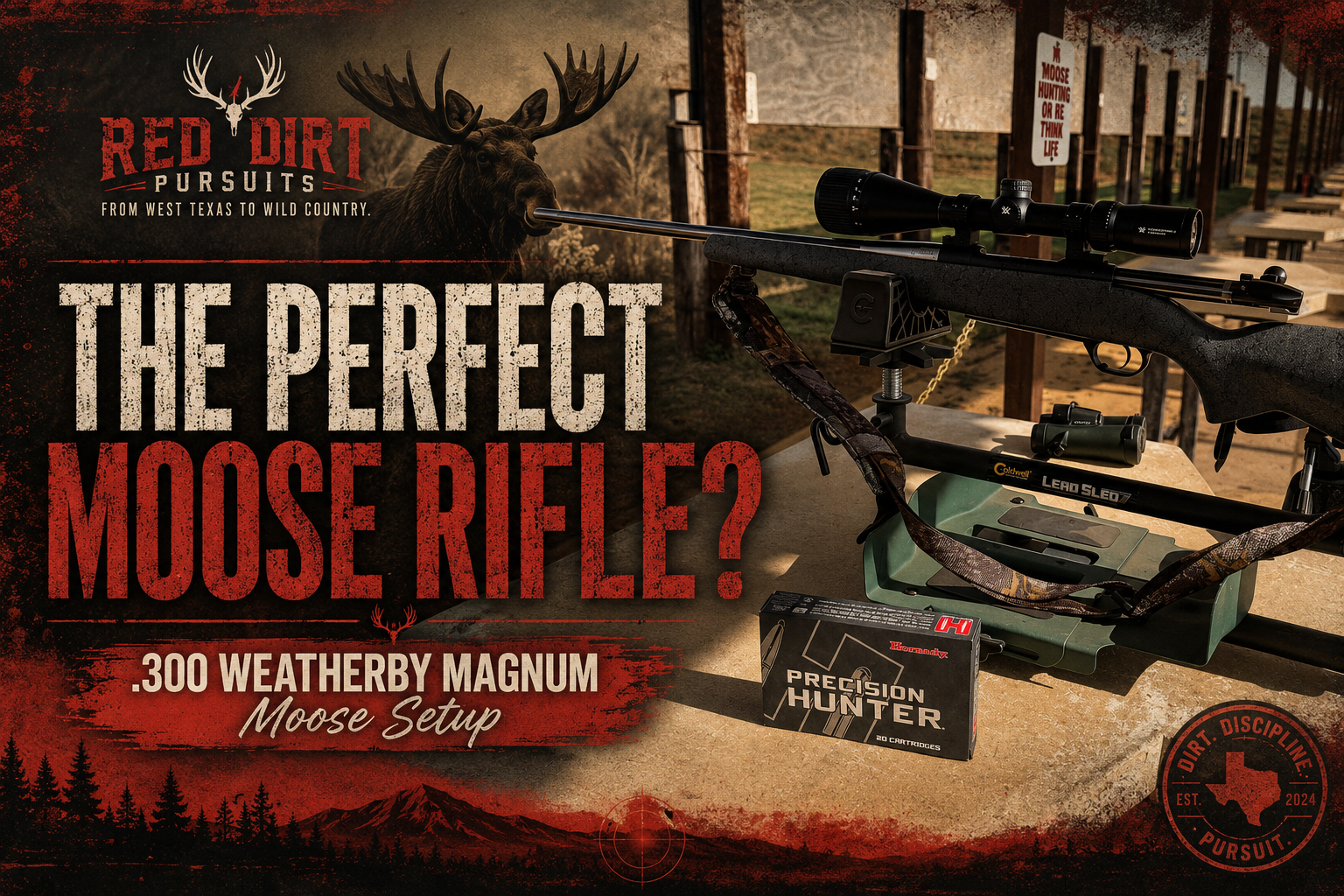
When you finally draw a moose tag, choosing the rifle setup becomes one of the biggest gear decisions of the entire hunt. Moose are massive animals, opportunities can be hard-earned, and the country can present everything from close shots in thick willows to longer shots across open parks and mountain valleys.
For my moose hunt, I wanted a rifle that gave me plenty of power, excellent downrange performance, and the confidence to make a clean, ethical shot when the opportunity finally presented itself.
My setup is straightforward:
Rifle: .300 Weatherby Magnum
Ammunition: Hornady Precision Hunter 200-grain ELD-X
Scope: Vortex Crossfire II 4-16×50
For the type of moose hunting I’m preparing for, it checks nearly every box.
Why the .300 Weatherby Magnum?
Moose are big.
A mature bull can weigh well over 1,000 pounds, with heavy muscle and bone protecting the vitals. You don’t necessarily need an enormous magnum to kill a moose, but I like having a cartridge that gives me plenty of capability without wondering whether I brought enough gun.
That’s where the .300 Weatherby Magnum shines.
The cartridge combines a heavy .30-caliber bullet with high velocity and substantial downrange energy. It also produces a relatively flat trajectory compared with many traditional big-game cartridges.
That matters in western hunting.
One day you might find a bull standing 80 yards away in the willows. The next opportunity could be across a drainage where the distance stretches considerably farther.
The .300 Weatherby gives me the flexibility to handle either situation.
There is a tradeoff: recoil. The .300 Weatherby Magnum isn’t a mild cartridge. Good shooting position, proper rifle fit and plenty of practice are important. All that horsepower doesn’t matter if you can’t consistently put the bullet where it needs to go.
But for a shooter who is comfortable with the rifle, the .300 Weatherby is an extremely capable moose cartridge.

Why the 200-Grain Hornady ELD-X?
A powerful cartridge is only half of the equation.
The bullet actually has to do the work.
For this setup, I’m using Hornady Precision Hunter ammunition loaded with the 200-grain ELD-X bullet.
I wanted a heavier bullet for moose rather than chasing maximum velocity with a lighter projectile. A 200-grain .30-caliber bullet gives me the combination I’m looking for: weight, penetration potential and strong downrange performance.
The ELD-X is designed as a hunting bullet with an aerodynamic profile intended to retain velocity and energy as distance increases.
That’s especially useful on a western hunt where I don’t know exactly what kind of shot the terrain is going to give me.
At closer distances, I’m still launching a heavy 200-grain hunting bullet from one of the fastest mainstream .30-caliber magnums around.
At longer distances, the bullet’s aerodynamic design helps preserve performance and reduces the amount of trajectory correction compared with slower combinations.
That doesn’t mean the cartridge turns a 500-yard shot into an easy shot. Distance still magnifies wind-reading errors, range errors and shooter mistakes.
It simply gives me a very capable platform to work with.

The Vortex Crossfire II 4-16×50
For glass, I’m running a Vortex Crossfire II 4-16×50.
I like the magnification range for this hunt because it gives me versatility.
At 4x, I have a practical field of view for closer encounters and situations where a moose suddenly appears in the timber or willows.
If I’m watching an opening or preparing for a longer shot, I can increase the magnification.
Having up to 16x gives me more than enough magnification for the distances at which I intend to shoot a moose.
The 50mm objective is another feature I like for a hunting rifle because moose movement can be especially good around the edges of daylight. Quality, usable glass matters when you’re trying to clearly identify an animal and establish a precise aiming point.
The Crossfire II isn’t Vortex’s highest-end optic, and I don’t pretend that it is. There are more expensive scopes with better glass, lighter designs and more advanced features.
But a hunting setup doesn’t have to be the most expensive combination available to work.
What matters is that the optic holds zero, the rifle and ammunition shoot consistently together, and I know exactly how the entire system performs before heading into the mountains.

Where This Setup Really Comes Together
The biggest reason I like this combination isn’t any single specification.
It’s versatility.
The .300 Weatherby Magnum provides the horsepower.
The 200-grain ELD-X gives me a heavy hunting projectile with strong downrange characteristics.
The 4-16×50 Vortex gives me a useful magnification range for changing terrain.
Put them together and I have a rifle capable of handling the different scenarios I could realistically encounter on a western moose hunt.
Thick Willows
If a bull steps into an opening at relatively close range, I can keep the scope at 4x and make a controlled shot without unnecessary magnification.
Open Country
If we locate a bull across a meadow or drainage, the .300 Weatherby’s trajectory and the ELD-X’s aerodynamic performance give me a capable combination for a longer shot—provided the distance is within my practiced limits.
Uneven Mountain Terrain
Real hunting rarely gives you a perfect shooting bench.
I may end up shooting prone, sitting, kneeling or using a rest. That’s why I’m spending time learning this setup rather than simply relying on the ballistics printed on the ammunition box.
Knowing the rifle matters more than owning the rifle.
The Most Important Part: Practice
It’s easy to get caught up in muzzle velocity, energy, ballistic coefficients and magnification.
None of those replace practice.
Before this rifle goes into the mountains, I want to know exactly what it does.
That means confirming zero, shooting the actual hunting ammunition, checking point of impact at multiple distances and practicing from realistic field positions.
I also want to know my personal maximum effective range.
The .300 Weatherby Magnum may be capable of sending a bullet effectively much farther than I’m willing to shoot at a moose. Those are two completely different numbers.
My maximum range is 300 yards maybe pushed out to 350 yards.I have successfully hunted elk with my weatherby and have shot them up to 300 yards with my rifle zerod in at 200 yards. I know this gun inside and out as it has been the same gun I have used on my large game hunts since I was 17.
Confidence Matters
Drawing a moose tag isn’t something I want to take for granted.
There could be days of glassing, hiking and working through rough country before everything finally comes together. When that moment happens, I don’t want to be questioning my equipment.
I want to settle behind a rifle I’ve practiced with, find the bull in the scope and concentrate on making the shot.
That’s why I’ve chosen the .300 Weatherby Magnum loaded with Hornady 200-grain ELD-X Precision Hunter ammunition and topped with a Vortex Crossfire II 4-16×50.
It’s powerful.
It’s versatile.
And most importantly, it’s a setup I can spend the months leading up to the hunt learning inside and out.
There may be lighter rifles. There may be more expensive scopes. There may be cartridges with less recoil.
But for my moose hunt, I’m not trying to build the trendiest rifle on the mountain.
I’m building a rifle I trust.
And when a bull finally steps out of those Colorado willows, that’s exactly what I want in my hands.